Control Systems The impulse response of a system is c(t) = -te-t + 2 e-t (t>0). Its open loop transfer function is (2s+2)/s² (2s+1)/(s+1)² (2s+2)/(s+1)² (2s+1)/s² (2s+2)/s² (2s+1)/(s+1)² (2s+2)/(s+1)² (2s+1)/s² ANSWER DOWNLOAD EXAMIANS APP
Control Systems A negative feedback closed loop control system is supplied to an input of 5 volt. The system has a forward gain of 1 and a feedback gain of 1. What is the output voltage? 2.5 Volt. 1.0 Volt. 1.5 Volt. 2.0 Volt. 2.5 Volt. 1.0 Volt. 1.5 Volt. 2.0 Volt. ANSWER DOWNLOAD EXAMIANS APP
Control Systems A transfer function has its zero in the right half of the s-plane. The function is minimum phase is non-minimum phase will give stable impulse response is positive real is minimum phase is non-minimum phase will give stable impulse response is positive real ANSWER DOWNLOAD EXAMIANS APP
Control Systems A second order control system has F(jω) = 100/(100 - ω² + 10√2 jω). Find the resonant peak? 0.5 0.707 1 1.5 0.5 0.707 1 1.5 ANSWER DOWNLOAD EXAMIANS APP
Control Systems The impulse response of a linear system is e-t, (t > 0). The corresponding transfer function is s/(s+1) 1/(s+1) 1/s 1/s(s+1) s/(s+1) 1/(s+1) 1/s 1/s(s+1) ANSWER DOWNLOAD EXAMIANS APP
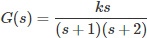
Control Systems The open loop transfer function of non unity negative feedback system is , then the number of root locus branches equal to 0. 3. 1. 2. 0. 3. 1. 2. ANSWER DOWNLOAD EXAMIANS APP
 EXAMIANS